

PMFME Scheme Drives Growth of 3,500 Millet Units and 10,500 Micro Food Enterprises in Karnataka
Bengaluru, June 23: Karnataka has emerged as a major force in micro food processing, with more than 10,500 micro food processing units receiving support under government schemes across the state, generating employment for an estimated 80,000 to 1 lakh people, according to the Karnataka Agro Processing and Export Corporation (KAPPEC).
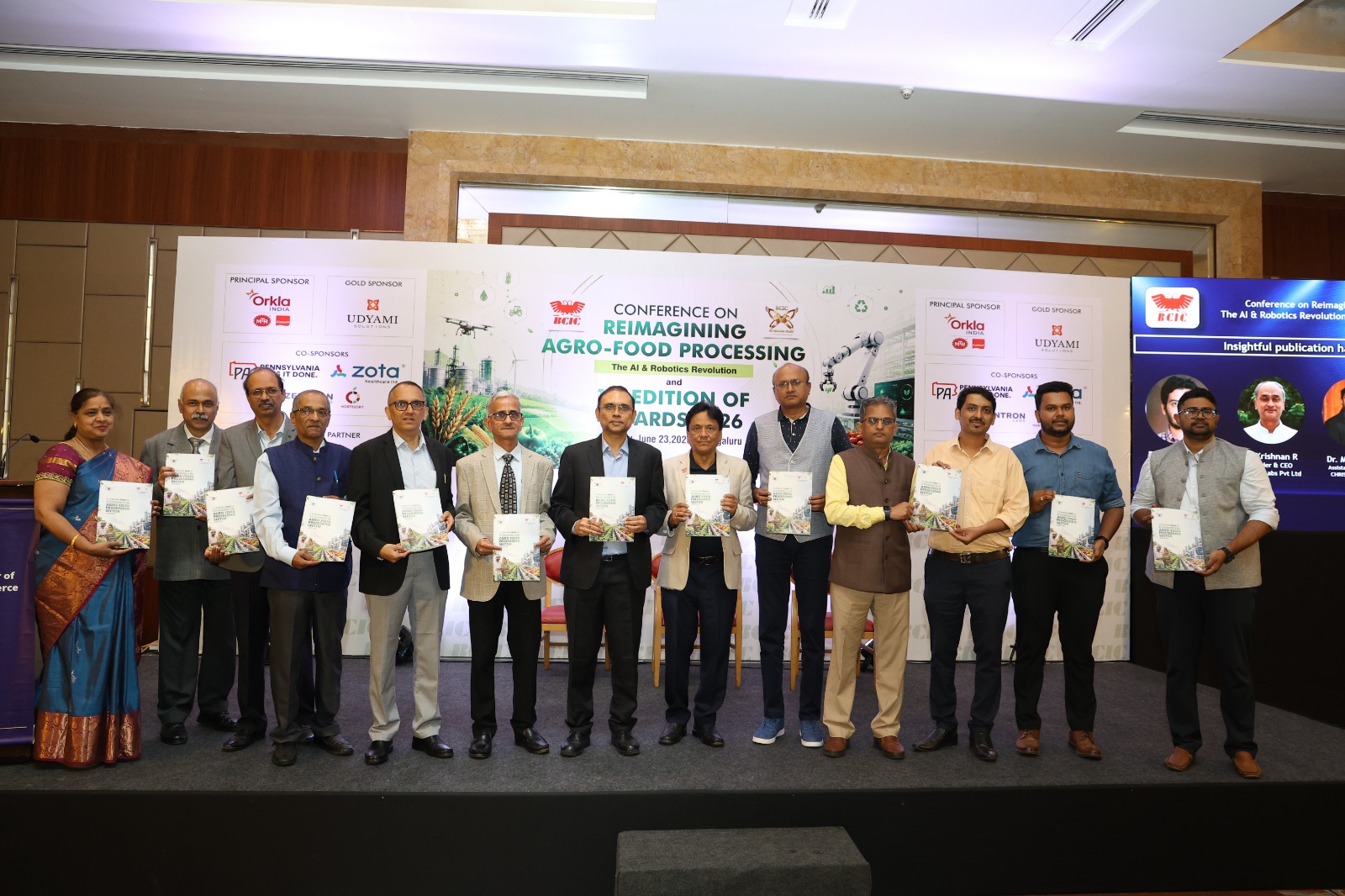
Speaking at the Conference on ‘Reimagining Agro-Food Processing: The AI & Robotics Revolution’ and the 1st Edition of Awards 2026, organized by the Bangalore Chamber of Industry and Commerce (BCIC), here, Shri C. N. Shiva Prakash, Managing Director, KAPPEC, said Karnataka has made significant progress in supporting entrepreneurs, producer collectives and food processing enterprises through the Prime Minister’s Formalisation of Micro Food Processing Enterprises (PMFME) Scheme.
Karnataka Emerges as a Food Processing and Millet Hub
“KAPPEC is always ready to facilitate an enabling ecosystem for food agripreneurship in the state. I congratulate BCIC for hosting such an impactful event. I am always in favour of technology and AI, but they should create more jobs rather than reduce them. Nevertheless, Karnataka is achieving milestones in food processing and I request major stakeholders such as BCIC to join hands in strengthening the sector,” he said.
He further noted that Karnataka has built a robust ecosystem for food processing with a special focus on millet-based industries. Highlighting the state’s leadership in the millet sector, he said Karnataka is home to more than 3,500 millet manufacturing and processing units, making it one of the strongest millet-processing ecosystems in the country.
The conference brought together policymakers, industry leaders, agri-entrepreneurs, technology experts and researchers to deliberate on the role of artificial intelligence, robotics, automation and innovation in transforming India’s agro-food processing ecosystem while ensuring inclusive growth for farmers and rural communities.
Food Processing Can Be a Pillar of Viksit Bharat 2047
Delivering a keynote address, Mr. Suresh Naryanan, former Chairman & Managing Director, Nestle India, said, “India’s food processing sector stands at a decisive inflection point. While the industry is already valued at over $300 billion and is projected to touch $535 billion by 2025-26, we are still processing only about 10% of our agricultural produce compared to 80% in developed economies. This gap represents India’s biggest opportunity for value addition, employment generation and rural prosperity. With strong government support through Rs. 4,064 crore budget allocations, the PLI scheme and over Rs. 9,227 crores in private investments, the foundation is in place.
The next leap must come from innovation, compliance-driven growth, healthier food portfolios and scaling niche sectors like millet-based superfoods, nutraceuticals and sustainable packaging. If India can align its policy, infrastructure and technology, food processing can become one of the strongest pillars of Viksit Bharat 2047.”
Mr. Prashant Gokhale, President, BCIC, emphasized that India must move beyond food self-sufficiency and position itself as a global food powerhouse.
“India today produces nearly 350 million tonnes of food grains and has achieved self-sufficiency for 1.5 billion people. But the next big question is: why stop at self-sufficiency? Why not become the ‘Food for the World’? We still lose nearly 30% of our produce to wastage, representing almost 100 million tonnes of additional food potential. With AI, robotics and advanced food processing, we can significantly reduce waste, create value-added products and strengthen global food security,” he said.
Drawing lessons from recent geopolitical disruptions, he added that India has a unique opportunity to emerge as a reliable global food supplier over the next decade and a half.
Setting the context for the conference, Mr. Ankur Bhaumik, Chairman, Agro and Food Processing Expert Committee, BCIC and Chief Operating Officer, Orkla India Ltd., said, “India has made remarkable progress in the last 50 years in achieving food security and remained resilient during geopolitical uncertainties. That reflects our strength and self-sufficiency. But at the same time, there have been rising global scrutiny on our exports and concerns of local compliance challenges. Next decade must be about quality, compliance and global competitiveness. Agriculture contributes 15% of GDP while supporting nearly 45 percent of our population. If India has to grow as an economy, farmer incomes must rise alongside it. Agriculture may have been a slow starter, but that is where the biggest opportunity lies. With immense headroom for growth, technology, innovation and value creation in agri and food processing will define the future.”
Industry Leaders Share Lessons in Agricultural Transformation
A panel discussion on ‘Unlocking India’s Agro-Food Potential: Enablers for Value Addition’, moderated by Mr. Prashant Gokhale, provided key insights into the future of India’s agricultural transformation.
Dr. N. V. Belavadi, former Executive Director, National Dairy Development Board (NDDB), highlighted the transformative impact of Operation Flood. “Operation Flood transformed India from a milk-deficit nation into the world’s largest milk producer. The Amul model demonstrated that farmer-owned cooperatives, backed by professional management, can drive large-scale and sustainable change. Market access, collectivisation and strong infrastructure remain the key pillars of agricultural transformation,” he said.
Mr. Shashi Kumar, Founder and CEO, Akshayakalpa Organics, stressed the importance of making farming economically attractive to younger generations.
“For decades, rural India has told its children to study well and leave farming behind. Twenty years ago, we asked ourselves whether farming could once again become aspirational. Today, with only 2,800 farmers, we produce 2.6 lakh litres of milk every day. In FY26 alone, we paid ₹480 crore to farmers, with average monthly earnings of ₹1.28 lakh per farmer. If farming is profitable and dignified, young people will return,” he said.
Mr. N. R. Shetty, Chairman, Sahaja Samrudha Organic Producer Company Ltd., reflected on Karnataka’s pioneering role in organic agriculture and millet promotion.
“My journey in organic farming began with a simple conviction, agriculture must prioritise not only production but also food quality and farmer well-being. Karnataka’s organic and millet movements have demonstrated that sustainable agriculture can create value for both farmers and consumers while promoting healthier food systems,” he said.
BCIC Releases White Paper on AI and Automation in Agro-Food Processing
As part of the conference, BCIC unveiled a White Paper on AI and Automation in the Agro-Food Processing Sector, positioning technology as a key enabler for enhancing productivity, value addition and market access while keeping farmers at the centre of the ecosystem.
Presenting the white paper, Mr. Jagadeesh Sunkad, Co-Chairman, Agro and Food Processing Expert Committee, BCIC, and CEO, Hitha Agri Fintech Pvt. Ltd., emphasized that discussions on AI and robotics must extend beyond operational efficiency.
“The conversation must focus on farmer inclusion, sustainability and competitiveness. Technology by itself does not create transformation. It is how we apply AI and automation to solve real problems for farmers, consumers and the food ecosystem that will define India’s agricultural future,” he said.
The white paper outlines how emerging technologies such as artificial intelligence, machine learning, deep-tech solutions and automation can strengthen agricultural value chains through better quality assessment, price discovery, direct farmer payments, traceability and market access. It also raises important questions on ensuring that India’s 120 million farmer families are not left behind in a technology-driven future.
BCIC Recognises Excellence in Agro-Food Processing
As part of the 1st Edition of BCIC Awards 2026, BCIC also felicitated outstanding entrepreneurs and enterprises that have demonstrated excellence, innovation and impact in the agro-food processing sector.
The conference highlighted the growing convergence of agriculture, technology and entrepreneurship, while reinforcing the need for collaborative efforts among industry, government, academia and farmers to build a globally competitive and sustainable agro-food ecosystem for India.