

WAIC’s AI Journey session addresses changing role of AI
Professionals from around the world talked about the key GenAI trends at the international AI conference in Shanghai
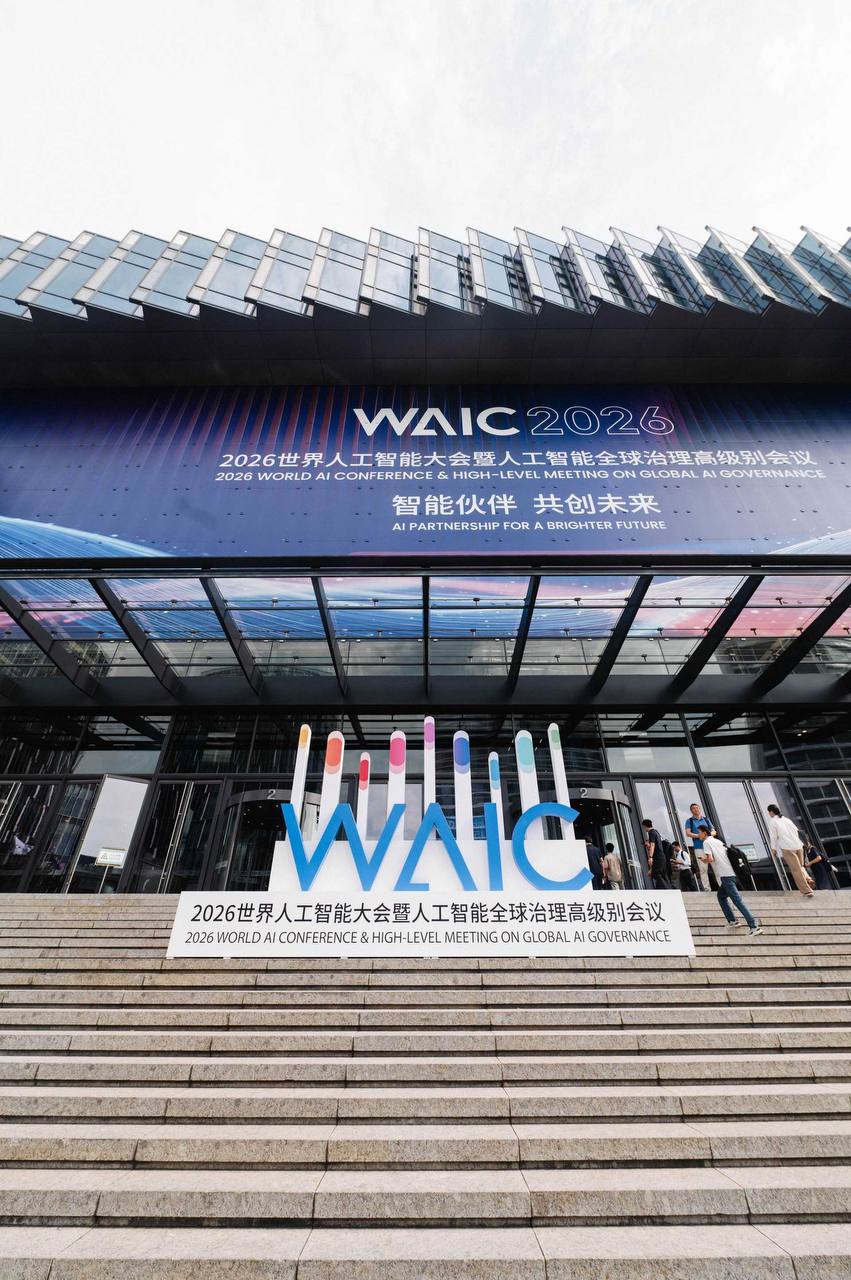
July 19, Shanghai: How is AI changing the software development industry and transforming companies? What model architectures are emerging on the market, and what is important to have trust in AI? These questions were key at the AI Journey session on “Creating Next-Gen AI” at the World Artificial Intelligence Conference (WAIC) in Shanghai.
Panelists discussed the transformation of industrial design, new large-scale model architectures, AI-native approaches to software development, and fundamental questions of trust in technology. Special attention was paid to the transition from AI as a simple assistant to a full-fledged economy of autonomous agents.
Economy of autonomous agents
The session was opened by Andrey Belevtsev, senior vice president and head of Technological Development at Sberbank, who noted the inevitability of the transition to an economy of autonomous agents. AI systems will independently execute transactions and manage physical processes, while humans will become high-level orchestrators of these processes. Sber is already developing the technological foundation for this, including the GigaNetwork platform, VLA models for robots, and new capabilities for two neural networks, GigaChat and Kandinsky.
Kirill Menshov, senior vice president and head of Technology at Sberbank, discussed the AI-Disrupt PDLC white paper and noted that the main constraint in the IT industry is no longer the speed of code writing, but the precision of thought. Businesses that build an end-to-end AI verification architecture and restructure teams to manage the context of model queries to achieve the desired result will emerge victorious.
Technology barriers and architectures of the future
The session continued with presentations by Russian and Chinese researchers. Sergey Markov, Director for AI Technology Development at Sberbank discussed the technology barriers of current architectures. In a situation where computing budgets for training advanced models are growing faster than the volumes of digitized data, a radical revision of the paradigms underlying the training of flagship AI models is required. The approach that combines massive pre-training on large volumes of texts with subsequent fine-tuning on dialogues created by experts may be replaced by approaches based on continuous and active training of models. Asynchronous recurrent architectures can take the place of massive monolithic models, capable of independently managing the time for reflection, depending on the complexity and urgency of the tasks being solved.
Head of Sberbank’s High-Potential AI Technology Development Semyon Budenny, Ph.D. in Physics and Mathematics, said in his presentation that true AI autonomy lies in abandoning centralization in favor of decentralization. The future lies in self-organizing agent-based graphs (gMAS) with a dynamic topology, where agents independently coordinate, manage memory, and verify actions throughout their life cycle.
Alexey Postnikov, executive director of the Sber Robotics Center, said that the transition from demonstrations to industrial implementation of robotics is impossible without VLA models and a reproducible testing system. Pilots must become part of the R&D with metrics and the ability of robots to cope with non-standard situations.
Evgeny Burnaev, PhD in Physics and Mathematics, professor at the Russian Academy of Sciences, vice president for AI Development and director of the Skoltech AI Center, and head of a research group at AIRI – Artificial Intelligence Research Institute, explained why most corporate AI projects have not yet progressed beyond the pilot stage. Scaling requires “engineer AI,” a unified environment in which AI agents can interact, accumulate experience, explain their decisions, and operate under human supervision. This approach allows for the transition from isolated experiments to the systemic implementation of AI in complex engineering and industrial processes.
New architectures and voice technology
Xuan Luo, RWKV developer and co-founder of YuanShi, stated that the era of transformer dominance is coming to an end. RWKV-7 has proven the competitiveness of linear RNN architectures, and the recognition of DeepSeek and Moonshot AI confirms the trend toward hybrid models and linear attention. Fudan University professor Xipeng Qiu, a CAAI fellow, presented a vision for the future of voice interaction: integrating end-to-end speech technologies (STT/TTS) with powerful LLMs to create dialog systems capable of synthesizing natural speech while taking context into account.
Managing AI technology
A panel discussion on AI governance concluded AI Journey. Andrei Neznamov, managing director of the Center for Human-Centric AI at Sberbank and a member of the UN Independent International Scientific Panel on AI, moderated the discussion, which featured experts from the AI Alliance, and speakers from China, Africa, and Brazil. The speakers discussed AI governance at all levels, from ecosystem to product, along with model security and the use of generative solutions with AI agents in the public sector. Participants agreed that AI governance is critical for scaling and achieving practical benefits.
WAIC visitors can enjoy the Russian Connected AI Hub, a booth where they can learn about Russian AI solutions for society, business, and government.