

Texas Governor-Elect Gina Hinojosa to Reverse H-1B Visa Freeze at Public Universities, State Agencies
Washington, Nov 20: Texas Governor-elect Gina Hinojosa has indicated plans to roll back restrictions on new H-1B visa petitions by state agencies and public universities, signalling a potential shift in the state’s immigration and workforce policies under the incoming Democratic administration.
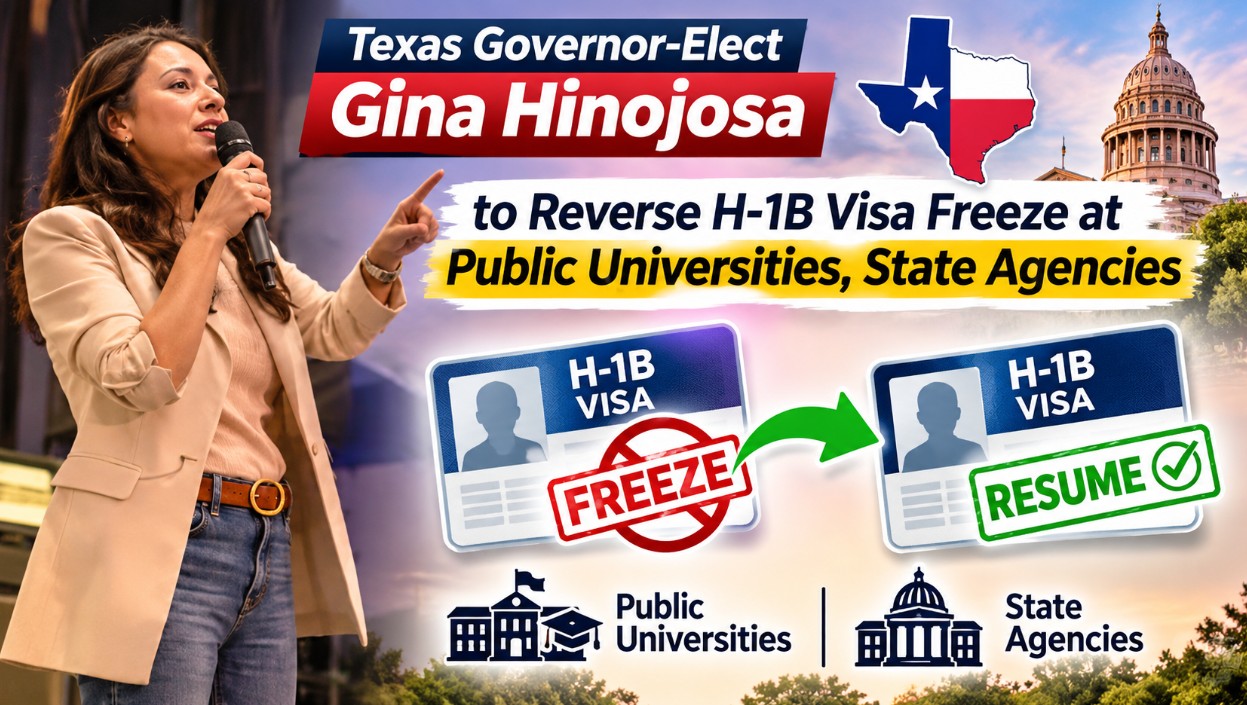
Representational Image
Hinojosa expressed opposition to the restrictions imposed by outgoing Governor Greg Abbott, saying the freeze did not make sense. In an interview with The Texas Tribune, she also said she was not elected to pursue “culture wars”, indicating her intention to focus on practical governance rather than political divisions.
The proposed policy reversal could be significant for international professionals, including thousands of Indian-origin workers who rely on the H-1B programme for employment in specialised fields such as technology, healthcare, education and research.
What Is Behind Texas’s H-1B Freeze?
Governor Greg Abbott introduced the restrictions through a directive dated January 27, requiring state agencies under gubernatorially appointed leadership and public institutions of higher education to obtain written approval from the Texas Workforce Commission before initiating or filing new H-1B petitions.
The restriction is scheduled to remain in place until May 31, 2027, unless changed earlier.
Abbott defended the move by arguing that taxpayer-funded institutions should prioritise employment opportunities for Texas residents. He said the temporary pause would provide lawmakers time to develop safeguards governing the recruitment of foreign workers by state-funded institutions.
The directive also required covered institutions to submit information about existing H-1B sponsorships, employees’ countries of origin, job responsibilities and recruitment efforts. The reporting deadline was March 27.
Existing H-1B Workers and Renewals Are Not Fully Affected
The restrictions do not amount to a complete ban on all H-1B-related applications in Texas.
Guidance cited by Texas State University indicates that visa renewals are not treated as new petitions requiring written approval. Certain changes of immigration status are also excluded, including qualifying transitions from F-1 student or J-1 exchange visitor status to H-1B status for eligible students and recent graduates already residing in the United States.
This means the directive primarily affects new H-1B sponsorships by the covered public institutions rather than every foreign professional or employer operating in Texas.
Hinojosa Criticises Misuse of H-1B Programme
Although supporting a reversal of the broad hiring restrictions, Hinojosa has also expressed concerns about potential misuse of the H-1B visa system.
Drawing on her background as a labour lawyer, she criticised companies that receive employment-related tax incentives but subsequently use those benefits to recruit H-1B workers.
She also pointed to the dependence of some school districts on overseas teachers, arguing that Texas should strengthen its own pipeline of qualified educators.
However, Abbott’s January directive specifically covers designated state agencies and public higher education institutions and does not explicitly include school districts.
Immigration Groups Welcome Proposed Policy Shift
The governor-elect’s position has received support from immigration advocacy groups.
FWD.us welcomed her opposition to the restrictions, arguing that the freeze could negatively affect public institutions and their ability to recruit international talent in critical sectors.
Zaira Garcia, the organisation’s regional government relations director, described the restrictions as harmful to Texans and said limiting international recruitment could undermine work in education, healthcare and research.
Hinojosa is scheduled to assume office on January 19. Her proposed reversal could reopen opportunities for public universities and state agencies seeking specialised international professionals, although the actual policy changes will depend on the steps taken by her administration.
For Indian professionals and international graduates looking towards opportunities in the United States, the development is worth watching. However, any reversal would concern Texas’s public-sector hiring restrictions and would not change federal H-1B eligibility rules or automatically grant visas to applicants.