

Modi Inaugurates First SCO Civilisational Dialogue Forum, Calls for Global Cultural Cooperation
New Delhi, Nov 21: From ancient trade routes and Buddhist learning centres to artificial intelligence and digital archives, India has called for a new chapter in cultural cooperation among Shanghai Cooperation Organisation (SCO) nations, with Prime Minister Narendra Modi asserting that shared civilisational heritage can offer a powerful foundation for global understanding and peace.
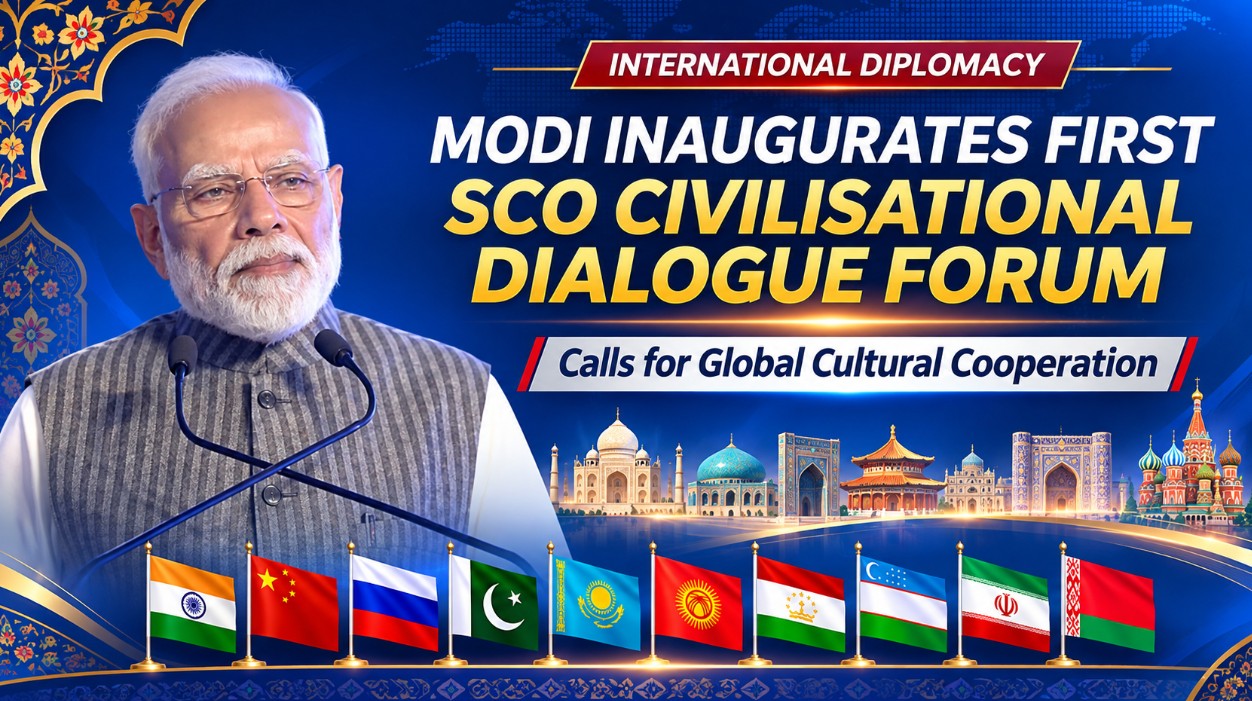
Representational Image
Inaugurating the first SCO Civilisational Dialogue Forum at the historic Purana Qila in New Delhi on November 20, Modi said that while empires had redrawn geographical boundaries over centuries, civilisational exchanges had transformed ideas and enriched societies across the world.
He described the forum as more than a ceremonial gathering, saying it could emerge as a platform capable of giving direction to global thinking at a time when international discussions are increasingly dominated by conflict and instability.
“Our shared civilizational experiences will play an important role in uniting the world,” the Prime Minister said, highlighting the importance of cultural connections alongside cooperation in security, trade and connectivity as the SCO marks its 25th anniversary.
Ancient Connections Offer Lessons for Modern Diplomacy
Using history to underline the enduring links between Asian societies, Modi traced cultural and commercial exchanges stretching back thousands of years. He referred to trade connections between the Indus Valley Civilisation and Mesopotamia, followed by networks that linked India with China, Central Asia and other parts of Eurasia.
These routes carried far more than merchandise. Merchants, scholars, travellers and religious teachers moved across regions, taking languages, literature, philosophies and scientific knowledge with them.
The Prime Minister highlighted the journeys of Buddhist travellers and scholars such as Faxian, Xuanzang and Yijing, as well as Kumarajiva, who was born in Kucha. He also pointed to the influence of major centres of learning and cultural exchange, including Nalanda, Kucha and Dunhuang.
Such historical links, he argued, demonstrate how societies have grown through the exchange of knowledge rather than isolation.
He illustrated this cultural movement through literary and intellectual traditions. The Indian Panchatantra travelled across linguistic and geographical boundaries, becoming known in Persian and Arabic as Kalila wa Dimna. Similarly, the Ramayana found new expressions in Southeast Asian cultures, including Cambodia’s Reamker.
Modi also referred to the journey of Indian mathematical knowledge to Baghdad, where scholars such as Al-Khwarizmi contributed to the further development of mathematics.
These examples, he said, show how ideas acquire new forms as they travel between cultures while continuing to influence generations.
From Ancient Manuscripts to Artificial Intelligence
A central theme of the Prime Minister’s address was the opportunity to use modern technology to preserve and share the cultural wealth of SCO countries.
He observed that geographical distances that once required months of travel can now be bridged within seconds through digital communication. Online platforms have also made it easier to exchange knowledge, promote cultural understanding and build international research partnerships.
Modi proposed greater cooperation among SCO members in digitising ancient manuscripts, translating historical texts and undertaking joint research into shared civilisational histories.
He particularly highlighted the potential of artificial intelligence in making important literary and intellectual works available in more languages.
Many valuable texts, he noted, remain accessible only to readers familiar with a limited number of languages. AI-assisted translation could help overcome this barrier and allow younger generations across different countries to explore one another’s intellectual traditions.
The Prime Minister said that a young person in any part of the world should be able to understand the cultural heritage of another country through easier access to historical documents, manuscripts and research.
Cultural Cooperation Beyond Museums and Archives
Modi also outlined a broader vision of cultural engagement that extends beyond the preservation of historical material.
He suggested joint exhibitions involving museums and cultural institutions, exchanges between scholars and researchers, and stronger academic partnerships among universities across SCO member states.
Heritage circuits connecting Silk Route locations and Buddhist sites could create new opportunities for cultural tourism and people-to-people interaction. Joint festivals, artist exchanges and collaborative cultural programmes could further deepen public understanding of the region’s shared traditions.
He also emphasised the role of young artists, writers and filmmakers in bringing civilisational heritage to contemporary audiences through digital media and creative platforms.
The Prime Minister said that younger generations, who are comfortable with technology and increasingly interested in global cultures, should be given greater opportunities to engage with different languages, literature and artistic traditions.
Purana Qila Provides a Historic Setting
The choice of Purana Qila as the venue added a historical dimension to the inaugural gathering. The ancient fort, associated in popular tradition with the Mahabharata-era city of Indraprastha, provided a setting for a programme that brought together cultural performances, Vedic recitations and presentations reflecting India’s spiritual and artistic traditions.
The Prime Minister referred to the performances, which included elements of Vedic heritage, Buddhist philosophy and Hanuman’s journey, as expressions of cultural values that reach beyond political and geographical boundaries.
He welcomed dignitaries, ministers, ambassadors, high commissioners, scholars, artists and other participants from SCO member states, expressing hope that the inaugural forum would establish a lasting tradition of civilisational dialogue.
He also pointed to shared cultural influences in music, architecture and artistic traditions. Connections between Central Asian Maqam and Indian Raga traditions, the influence of Sufi traditions on Qawwali, and the contribution of Central Asian garden designs from Samarkand and Herat to the Charbagh style were cited as examples of centuries of interaction.
These exchanges, he said, underline the importance of keeping cultural relationships open and active.
‘Vasudhaiva Kutumbakam’ at the Heart of India’s Message
Concluding his address, Modi connected the idea of civilisational dialogue with India’s philosophical tradition of Vasudhaiva Kutumbakam — the belief that the entire world is one family.
He said the wellbeing of individual societies and nations is closely linked to global welfare, making mutual respect, goodwill and harmony essential for international stability.
Drawing on India’s experience of living with diverse languages, customs and traditions, he argued that differences need not divide societies and can instead become a source of collective strength.
The Prime Minister also invoked the Vedic message, “Sangachchhadhwam Samvadadhwam Sam Vo Manansi Janatam”, calling for people to move together, communicate together and develop a shared understanding.
The inaugural SCO Civilisational Dialogue Forum thus placed cultural cooperation at the centre of a wider conversation about international relations. Its proposed initiatives — from digital preservation and AI-enabled translation to academic exchanges and heritage tourism — offer possible avenues for turning centuries-old connections into practical cooperation for the future.
The larger message from New Delhi was that the shared history of nations need not remain confined to museums and historical records; it can also help shape a more connected, informed and cooperative world.