

India Achieves Near-Universal Banking Access, 99.92 pc of Villages Now Covered
New Delhi, Aug 4: India has achieved a major milestone in financial inclusion, with 99.92 per cent of inhabited villages now having access to banking services within a five-kilometre radius, the government said.
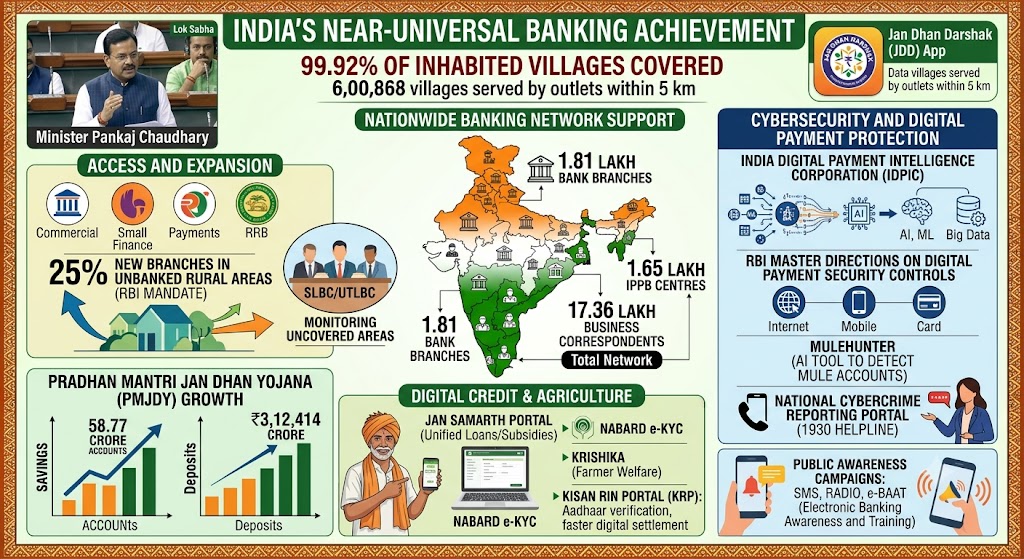
Minister of State for Finance Pankaj Chaudhary informed the Lok Sabha that 6,00,868 out of 6,01,328 inhabited villages are covered through a combination of bank branches, Business Correspondent (BC) networks and India Post Payments Bank (IPPB) outlets. The figures are based on data uploaded by banks on the Jan Dhan Darshak (JDD) App.
Representational Image
The expansion marks a significant step towards ensuring wider access to formal financial services in rural and remote parts of the country. As of July 17, 2026, India’s banking ecosystem included more than 1.81 lakh bank branches, 17.36 lakh Business Correspondents, and 1.65 lakh IPPB centres, creating a vast network for delivering banking facilities.
The government said it is continuing efforts to ensure that every inhabited village has access to a banking outlet. Under existing RBI guidelines, commercial banks, small finance banks, payments banks, local area banks and regional rural banks can open branches across the country without prior approval, subject to the condition that at least 25 per cent of new branches are established in unbanked rural areas.
The progress in rural banking access is being monitored through State Level Bankers’ Committees (SLBCs) and Union Territory Level Bankers’ Committees (UTLBCs), which coordinate with state governments, banks and other stakeholders to identify uncovered locations and improve service delivery.
The government also highlighted the continued impact of the Pradhan Mantri Jan Dhan Yojana (PMJDY) in expanding financial inclusion. The scheme has resulted in the opening of 58.77 crore bank accounts, with total deposits reaching ₹3.12 lakh crore as of July 17, 2026.
Alongside expanding banking access, the government has accelerated digital initiatives to improve credit availability, particularly for agriculture and rural borrowers. Platforms such as the Jan Samarth Portal, Kisan Rin Portal, KRISHIKA, and NABARD’s e-KYC application are helping streamline loan applications, beneficiary verification and credit delivery.
The government and the Reserve Bank of India have also stepped up measures to improve cybersecurity and prevent digital payment fraud. The India Digital Payment Intelligence Corporation (IDPIC) enables banks and financial institutions to exchange fraud-related intelligence, while the RBI’s AI-powered MuleHunter tool helps identify suspicious money mule accounts.
Officials said the combined focus on banking expansion, digital infrastructure, credit access and cybersecurity will continue to support inclusive economic growth and strengthen India’s financial ecosystem.