

NIT Rourkela Patents Hybrid EV Charging System to Boost Battery Life and Grid Efficiency
Rourkela, Nov 26 (UDN): In a significant development for India’s electric mobility sector, the National Institute of Technology (NIT) Rourkela has secured a patent for an innovative smart electric vehicle (EV) charging system designed to improve battery life, reduce dependence on conventional electricity and ease the burden on the power grid.
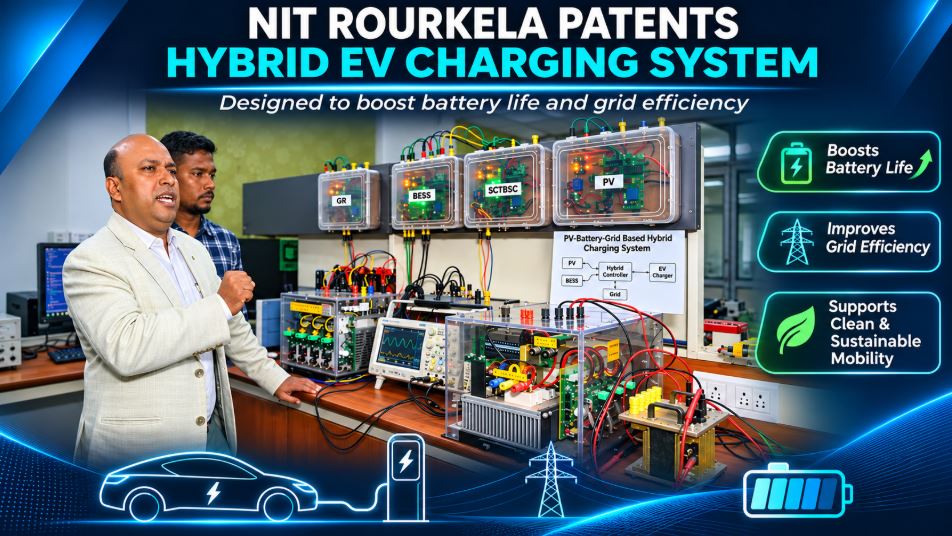
The newly developed technology integrates solar energy, battery storage and supercapacitors to create a more efficient and sustainable EV charging infrastructure. It also incorporates Vehicle-to-Grid (V2G) technology, enabling electric vehicles to supply stored electricity back to the grid whenever required.
Hybrid Technology Aims to Extend EV Battery Life
With the growing adoption of electric vehicles, the demand for charging infrastructure has increased considerably. However, simultaneous charging of multiple vehicles can put additional pressure on the electricity grid. Variations in solar power generation and repeated charging and discharging cycles can also affect the efficiency and longevity of EV batteries.
The NIT Rourkela innovation seeks to address these challenges through an intelligent power management system.
The research team is led by Professor Prabhat Kumar Ray, along with Arnab Ghosh and Dr Anindya Bharati.
Explaining the technology, Professor Ray said the system uses advanced power management algorithms and specialised hardware to coordinate different energy sources. It combines batteries and supercapacitors with multiple power converters to ensure efficient electricity distribution.
Under this arrangement, batteries provide power for longer durations, while supercapacitors manage sudden surges in electricity demand. This division of workload helps minimise battery stress, potentially improving battery performance and extending its operational life.
Vehicle-to-Grid Technology Adds a New Dimension
One of the key features of the patented system is its Vehicle-to-Grid capability. The technology allows electric vehicles not only to draw electricity for charging but also to return stored energy to the power grid during periods of high demand.
This two-way flow of electricity could help improve grid flexibility and make better use of renewable energy.
Professor Arnab Ghosh said the system could offer economic and environmental benefits by reducing dependence on fossil fuels. He also highlighted its potential applications in residential settings and remote areas where reliable electricity supply and charging infrastructure remain challenging.
Prototype Tested, Further Trials Planned
According to researcher Aradhana Khilo, the project has been under development for approximately two years, with an investment of around Rs 10 lakh.
The initiative has been designed in line with the growing need for cleaner energy alternatives and sustainable transportation solutions.
The research team has already developed and tested a prototype. The next phase will focus on increasing the system’s capacity and conducting trials under real-world operating conditions to assess its performance and practical applications.
A Potential Boost to India’s Green Mobility Mission
The development could open new possibilities for integrating renewable energy into India’s expanding EV charging network. By combining solar power, energy storage and bidirectional charging, the technology offers a potential solution to some of the key challenges associated with large-scale electric vehicle adoption.
If successfully scaled and deployed, the innovation could support more reliable charging infrastructure, improve energy management and contribute to India’s broader clean-energy ambitions, including its target of achieving net-zero emissions by 2070.