

Human + AI: Amity University Haryana Launches 5-Day National Programme on Responsible AI and Ethics
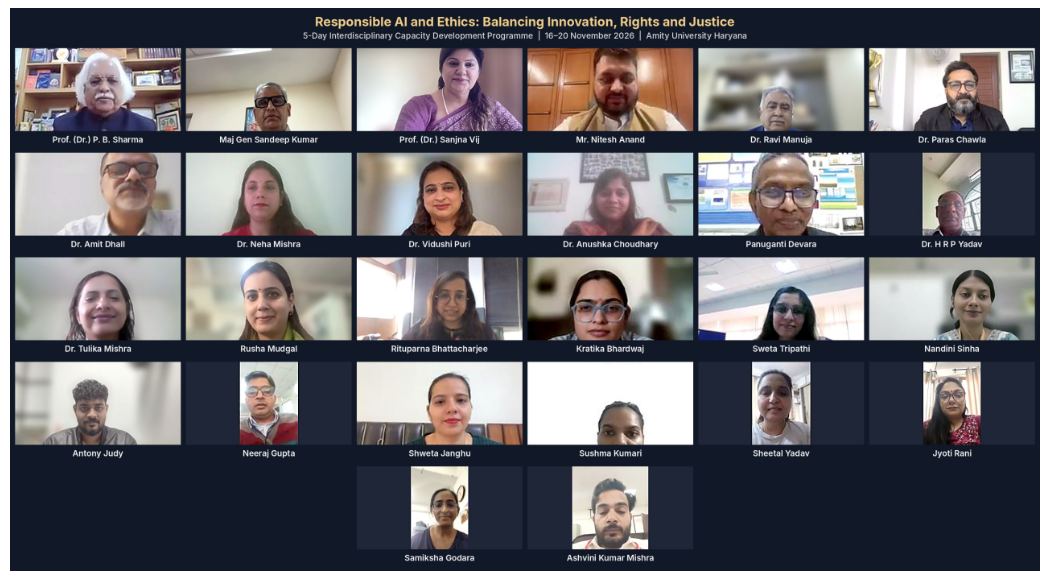
Gurugram, Nov 18: Amity University Haryana inaugurated a 5-Day Interdisciplinary Capacity Development Programme on “Responsible AI and Ethics: Balancing Innovation, Rights and Justice” on 16 November 2026, under the AIU-AADC (Academic and Administrative Development Centre) Initiative of the Association of Indian Universities (AIU). The programme is organised by the Amity Academic Staff College, the Centre of Excellence for Innovation in Education and Amity Law School, in collaboration with the Centre for Civil Society (CCS), New Delhi, and runs online from 16 to 20 November 2026.
The inaugural ceremony began with a virtual lamp lighting and Saraswati Vandana followed by a short film, Responsible AI 2026: The Future Is Human + AI, which opened with the question, “Should AI decide for you?”
The Chief Guest, Prof. (Dr.) Pankaj Mittal, Secretary General, Association of Indian Universities, delivered the Inaugural Address, she explained that the AADC initiative was launched to train teachers in the use of technology and AI for teaching, learning, research and governance, while ensuring it is not used unethically. Prof. Mittal urged educators to change the question they ask: “It should not be can AI do it, but should AI do it.” She said, “AI has to be a mirror, not a master. AI is neither good nor bad; it is a mirror of us. If we feed it biased data, it will give biased results. If we teach it to cheat, it will help us cheat. Responsible AI begins with responsible humans.” She highlighted three ethical challenges – truth versus deepfakes, privacy versus convenience and the impact of AI on jobs – and outlined three principles of Responsible AI: transparency, accountability (“We cannot say the computer did it; the human must be accountable”) and trust ensuring AI is fair, unbiased and inclusive. She also encouraged teachers to use AI for personalised learning, assessment, research and governance, ethically and responsibly.
The Hon’ble Vice Chancellor, Prof. (Dr.) P. B. Sharma, Amity University Haryana congratulated the organisers for a programme of great relevance to everyone, whatever their position or responsibility. Prof. Sharma observed that AI will continue to grow more powerful and could one day become “both a good master and a bad master” of humanity. Prof Sharma called for developing “silicon with a soul” – AI systems with inbuilt corrective measures that prevent them from causing harm – so that responsibility and accountability are embedded within the algorithms and decision-making systems of tomorrow. Drawing on India’s civilisational values of truth, righteous conduct and kalyanam (the welfare of all), Prof. Sharma emphasised that character and behaviour must be given as much importance as capability and knowledge. Noting that “our forefathers emphasised duties and responsibilities more than rights,” he urged higher education institutions to build systems, pedagogy and curricula that support “a fair, just and equitable society,” and called on teachers to commit “with head, heart and soul” to nurturing responsible citizens.
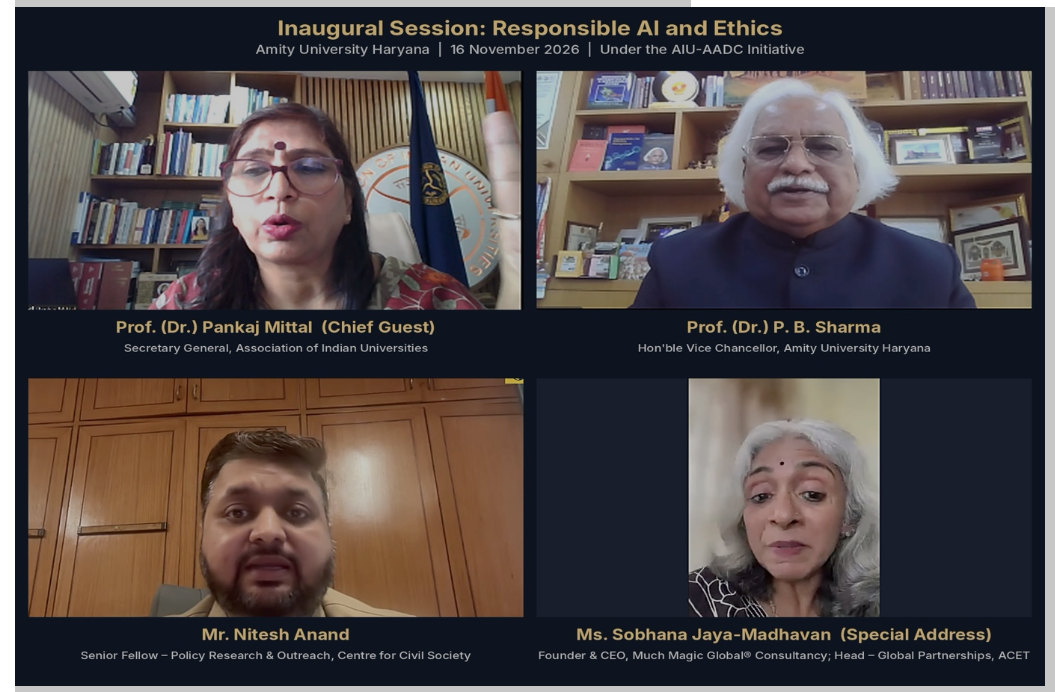
Mr. Nitesh Anand, Senior Fellow – Policy Research & Outreach, Centre for Civil Society, New Delhi, spoke on the public-policy perspective. Using the example of a Mumbai pizzeria’s drone delivery in 2014, which was grounded under a 1934 law written for aircraft, he said, “India does not need less regulation of technology. It needs better regulation of technology.” He proposed four questions to judge any rule – necessity, subsidiarity, proportionality and sunset, or “whether, who, how much and how long” – and invited participants to treat their institutions as “small policy laboratories.” He offered CCS’s support to faculty and students as researchers, interns and co-authors.
Delivering a Special Address, Ms. Sobhana Jaya-Madhavan, Founder & CEO, Much Magic Global® Consultancy, and Head – Global Partnerships, ACET, drew on her three decades in Canada to frame AI ethics around two ideas: purpose and progress. She cautioned that unequal access to advanced AI tools could widen inequality, and urged institutions to teach technology together with its social, environmental and ethical consequences. Sharing the wisdom of Canada’s Indigenous Haida community of thinking about “the next seven generations,” she reminded educators: “We are more than teachers. We are role models.”
Maj Gen Sandeep Kumar, AVSM, VSM, Dean and Director, Amity Law School, Amity University Haryana, raised key questions: Can we trust an algorithm’s decision without question? Who is responsible when AI discriminates against an individual? How do we protect privacy and dignity? “These questions cannot be answered by technology alone,” he said. Referring to the Supreme Court’s concern over lawyers citing AI-generated cases that do not exist, he stressed that “accountability cannot be transferred to a machine,” and that the constitutional guarantees under Articles 14, 19 and 21 must remain intact. “AI can be a good servant, but it will always be a very bad master,” he said. “Efficiency is not justice. Speed is not fairness.”
Prof. (Dr.) Sanjna Vij, Prof of Liberal Arts and Director, Amity Academic Staff College, and Head, Centre of Excellence for Innovation in Education, welcomed the dignitaries and participants. She posed the central question of the program: “Are we developing technology faster than we are developing the wisdom to use it responsibly?” Prof. Vij acknowledged the vision of the Founder President, Dr. Ashok K. Chauhan, and the encouragement of the Chancellor, Dr. Aseem Chauhan, and thanked AIU and CCS for their partnership. “AI may give us speed, information and new possibilities, but it is human wisdom, human judgement and human values that will guide us in the right direction,” she said. “Let us learn not just to use AI, but how to use it responsibly.”
The session concluded with a Vote of Thanks by Dr. Ravi Manuja, Registrar, Amity University Haryana, followed by a pre-programme assessment of participants’ awareness of Responsible AI and ethical decision-making.
Over the five days, participants from universities, colleges, the legal profession and government across eight states will engage with experts from leading institutions, including the University of Delhi, The West Bengal National University of Juridical Sciences (WBNUJS), Kolkata, Vidhi Centre for Legal Policy, the American University of Technology, Tashkent, and Amity University, on AI governance, transparency and accountability, data protection and privacy, algorithmic bias and digital justice, generative AI and intellectual property, academic integrity and Responsible AI in higher education. Each day combines case-based discussions with hands-on practice exercises and reflection.
About the Programme
The 5-Day Interdisciplinary Capacity Development Programme on Responsible AI and Ethics: Balancing Innovation, Rights and Justice is conducted under the AIU-AADC Initiative of the Association of Indian Universities. It aims to build awareness and practical skills among faculty, researchers, legal professionals and administrators for the ethical, transparent and human-centred use of Artificial Intelligence.