

India Calls for Climate Justice and Climate Finance at COP31 in Türkiye
Antalya, Nov 18: India has called on developed countries to take greater responsibility for addressing climate change, arguing that developing nations should not be forced to shoulder the consequences of historical greenhouse gas emissions at the cost of their development priorities.
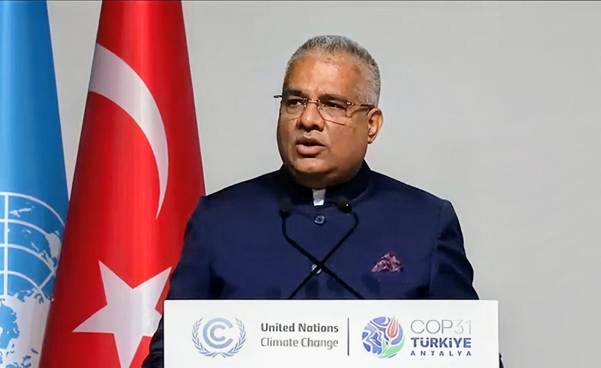
Delivering India’s national statement at the UN climate conference COP31 in Antalya, Türkiye, Union Environment, Forest and Climate Change Minister Bhupender Yadav said global climate action must be guided by equity, climate justice and the principle of Common but Differentiated Responsibilities and Respective Capabilities (CBDR-RC).
Linking his remarks to the conference theme of ‘Dialogue, Consensus and Action’, Yadav said international cooperation must translate into fair decisions, adequate financial support and practical outcomes.
India flags historical responsibility for climate change
The Minister pointed to nearly two centuries of industrialisation and economic expansion in some parts of the world, supported by sustained greenhouse gas emissions, as a major contributor to the current climate crisis.
He argued that developing countries should not be expected to carry an unfair share of the burden in the name of greater climate ambition.
According to Yadav, climate commitments must not force developing nations to choose between environmental protection and their legitimate development needs, including better living standards, healthcare and education.
He also described equitable access to the remaining global carbon budget as essential to ensuring fairness in the transition towards a low-carbon future.
Climate negotiations must reflect equity
India urged countries to ensure that decisions taken under the UN Framework Convention on Climate Change (UNFCCC) remain firmly rooted in the CBDR-RC principle.
Yadav called for the Mitigation Work Programme to retain a facilitative rather than prescriptive approach. He also said the Global Stocktake should continue to serve as a tool to inform countries’ decisions, while the proposed Just Transition Mechanism must be grounded in equity.
The Minister further cautioned against unilateral trade measures introduced in the name of climate action that could disadvantage developing economies.
Developed nations urged to meet climate finance commitments
A central demand in India’s statement was the fulfilment of climate finance obligations by developed countries.
Yadav called for these commitments to be delivered honestly and without delay, stressing that developing nations need adequate resources to pursue climate action while meeting their development objectives.
He also highlighted the importance of accounting for changing climate conditions, demographic shifts and technological progress when shaping international cooperation.
India’s climate goals linked to Viksit Bharat 2047
Highlighting India’s climate commitments under Prime Minister Narendra Modi, Yadav said the country’s Nationally Determined Contributions (NDCs) are aligned with the goal of building a sustainable and developed India by 2047.
He stressed that COP31’s success should be measured not merely through negotiated declarations but through implementation on the ground, the flow of resources to countries and communities that need them, and the expansion of proven climate solutions.
India’s message at the conference was that ambition must be matched by fairness and support. Yadav said dialogue should build trust, consensus should protect equity, and concrete action should deliver climate justice.