

IIM Bangalore’s Center for Digital Public Goods (CDPG) and Protean eGov Technologies release ‘State of DPI in India 2026’ report
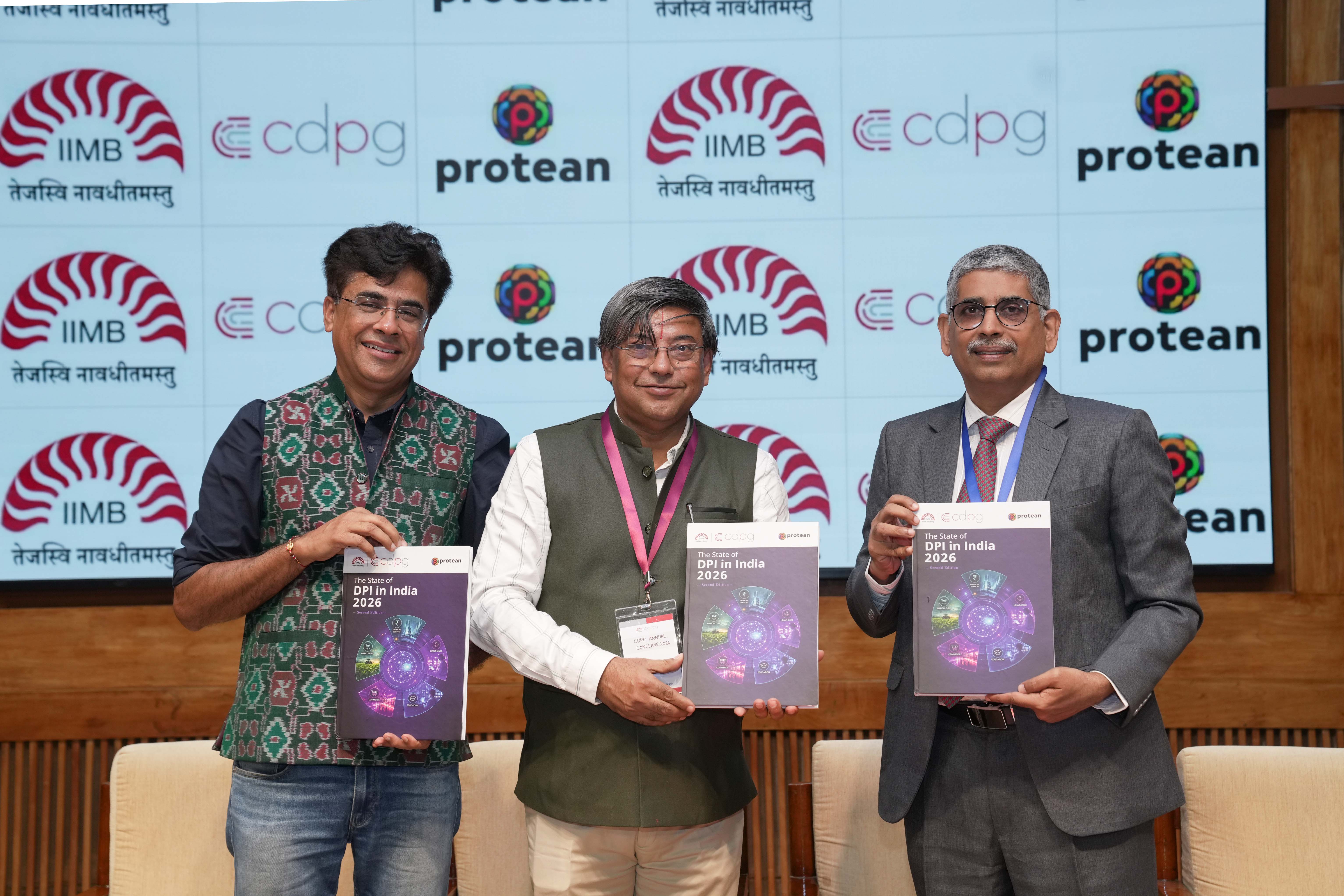
Bengaluru, Oct 01: The Center for Digital Public Goods (CDPG) at IIM Bangalore today released the second edition of the ‘State of DPI in India 2026’ report at the Annual Policy Conclave, organized by CDPG in partnership with eGov Foundation, at IIM Bangalore. The report was unveiled by Mr. V Easwaran, COO, Protean eGov Technologies, Mr. Viraj Tyagi, CEO, eGov Foundation, and Prof. R Srinivasan, Chairperson, CDPG and faculty of the Strategy area at IIMB.
Commissioned by Protean eGov Technologies Ltd. and authored by CDPG at IIM Bangalore, the ‘State of DPI in India 2026’ report examines the evolution of India’s DPI ecosystem and assesses implementation across five sectors: financial services, healthcare, agriculture, commerce and education. Building on the DPI maturity framework introduced in the first edition, the second edition expands the analysis to three additional sectors and examines how shared digital infrastructure is enabling coordination across increasingly complex ecosystems.
The report states that India has demonstrated its ability to build and scale digital infrastructure to population level. Its findings suggest that the next phase of the DPI journey, moving beyond the creation of individual digital guardrails, will steer toward connecting existing infrastructure into interoperable networks, building digital institutions around them, and enabling trusted interactions across increasingly complex ecosystems.
“Through comparative analysis and interactive visualizations, the 2026 edition of the ‘State of DPI in India’ report builds on the Center’s efforts to develop an evidence base on India’s evolving DPI landscape and contribute to the global discourse on how open, reusable and interoperable DPI can advance inclusive growth, institutional coordination and resilient public-service ecosystems”, said Prof. R Srinivasan, Chairperson, Center for Digital Public Goods (CDPG), IIM Bangalore.
Mr. V. Easwaran, Executive Director & Chief Operating Officer, Protean eGov Technologies Ltd. said, “Protean has had the privilege of being part of India’s digital transformation journey from its early chapters, and it is deeply rewarding to see how that journey has evolved into a globally relevant conversation around Digital Public Infrastructure. For us, DPI has always been about more than technology; it is about building trusted systems that make everyday interactions simpler, more inclusive and more accessible. Our association with the Center for Digital Public Goods at IIM Bangalore gives us an opportunity to step back, reflect on how far the ecosystem has come, and contribute to the thinking on where it goes next. The ‘State of DPI in India 2026’ report captures that transition beautifully, from building foundational rails to creating connected, interoperable ecosystems that can unlock the next generation of public and private innovation. We are proud to support CDPG in bringing this important body of work to the wider ecosystem”.
DPI 1.0 to DPI 2.0
A central theme of the report is the transition from DPI 1.0 to DPI 2.0. The first phase of India’s DPI journey was primarily focused on building foundational rails for identity, payments and digital service delivery. The emerging phase is characterized by greater interoperability among identity systems, payments, credentials, registries, consent frameworks, data-sharing systems and sector-specific infrastructure.
The five sectors examined in the report illustrate different dimensions of this evolution. Financial services demonstrate the scale and maturity possible through interoperable digital transactions. Healthcare is developing connected health information infrastructure through shared registries and consent-based systems. Agriculture is using interoperable infrastructure to address fragmentation across farmers, markets, advisory services and government programmes. Commerce is seeing the emergence of interoperable digital marketplaces, logistics and procurement systems, while education is developing shared infrastructure for learner identity, portable credentials, digital learning and continuity across the learning journey.
Measuring DPI maturity
In particular, the report’s analysis indicates that DPI maturity is better understood as an evolutionary process than a binary outcome. The same is reflected in the varying stages of implementation and adoption in the five sectors examined, with financial services having progressed toward widespread leverage.
Accordingly, the report assesses DPI not only through technological deployment, but also through institutional adoption, ecosystem participation, user trust and the emergence of innovation around shared digital infrastructure.
Across sectors, the report identifies cross-ecosystem coordination as a critical determinant of DPI value. As digital infrastructure expands, the challenge increasingly involves enabling governments, businesses and citizens to interact across institutional boundaries through common standards, trusted data exchanges, shared registries and appropriate governance arrangements.
DPI as institutional innovation
The report also positions DPI as an institutional innovation, rather than solely a technological one. Technology can create the infrastructure for interaction, but its effectiveness depends on the institutional arrangements, standards, incentives and governance mechanisms that enable different ecosystem participants to work together.
This becomes particularly significant as DPI expands across ministries, departments and levels of government. The report points towards the need for a more whole-of-government (WoG) approach in which interoperable systems and coordinated governance can support more seamless citizen experiences across traditionally fragmented public services.
Towards DPI 3.0
On the future ahead, the report considers how emerging technologies, particularly artificial intelligence (AI), could add a new intelligence layer to DPI. As digital infrastructures become increasingly interconnected, AI could potentially draw on multiple trusted infrastructures to support decision-making, anticipate needs and enable more personalized and coordinated services.
The report cautions that the proliferation of AI and its deeper integration in digital ecosystems must be accompanied by governance mechanisms that embed privacy, accountability, transparency and interoperability into digital infrastructure. Techno-legal frameworks that underpin these pillars will also be critical to maintaining trust.
The report consequently looks beyond DPI 2.0 towards DPI 3.0, in which digital institutions could increasingly support intelligent coordination across governments, markets and society.