
90% of the monuments of the world are built using Indian stones exported, according to the FIGSI office bearer
Hyderabad, May 29…..Speaking at the inauguration, Rajesh Angara, Chairman, Quarrying Development & Environment & Ecology, Sub-Committee and a very senior office bearer of the Federation of Indian Granite and Stone Industry (FIGSI), highlighted India’s pivotal role in shaping some of the world’s most iconic landmarks. He noted that Indian natural stones are renowned globally for their quality, durability, colour range, and craftsmanship, and are exported to more than 120 countries.
“An estimated 90 per cent of the world’s major monuments, memorials, public spaces, commercial complexes, and architectural landmarks feature stone sourced from India in one form or another,” he said.
He further stated that India is one of the world’s largest producers and exporters of granite, marble, sandstone, limestone, and quartzite, supplying premium stone products to projects across North and South America, Europe, the Middle East, Asia, and Africa. The growing global demand for Indian stone reflects the country’s rich geological resources, advanced processing capabilities, and commitment to quality standards.
80 to 90% of the stone is left as waste in stone mining. The government should come out with a policy encouraging the use of such waste used in the construction of public infrastructure and utility places for the public. Stone waste can be used in slabs, tiles, cubes, cuboids and several other value-added products.
Speaking along with Mr Deepak Goyal, Praveen Goyal, organisers of the first-ever expo of its kind in the Telugu States, Stone & Tech Expo 2026, said most countries in the West, especially in Europe, use stone in constructing public utilities for a long-lasting impact. Whereas the governments in India use tiles, artificial stones made using sand, which do not last long and suggested that they shift to stone. Stones made of artificial sand are not reliable. India has a rich culture of stone, he added.
Telangana and Andhra Pradesh are known as the Ratna Garbha of the Country. The expo is more relevant to Telangana, as the two Telugu states together are the largest regions for natural stone in India. Nearly 80% of Telangana’s granite production is export-oriented, reflecting the state’s strong international market presence. This region is known for its unique and most popular stone material.
There are 1.5 lac stone-related enterprises across India. The size of the industry is Rs 60,000 crore under the organised sector. The size of the industry in Telangana and Andhra Pradesh is 8000 crores. The sectors across India employ around 15 lakhs, and in the Telugu states, 1.5 lakh, both direct and indirect sectors together
The taxes on the stone industry are abnormally high in Telugu states when compared to other states like Rajasthan and Karnataka in India, and China, Brazil, and Turkey abroad. It is three times more here. When compared to other countries, we have high taxes and many hard core compliances. Government must relook at the same, he appealed that the country should adopt one nation and one tax on natural minerals across states.
The Expo was inaugurated by Mr Yashwant Sharma, Shri Bhagwati Machines, Ajmer, one of India’s prominent manufacturers of stone-processing machinery; Mr Rohit Saraf of Vinayaka Stone Tech a South India–based company specialising in stone-processing tools; Rajesh Angara with few office bearers and representatives of the Federation of Indian Granite and Stone Industry, the apex industry body representing India’s natural stone sector, also graced. FIGSI promotes Indian natural stones such as granite, marble, sandstone, slate, and quartzite in domestic and international markets and is considered one of the most influential organisations in India’s stone industry
The expo has 100 stalls, of which three are set up by Chinese companies and the remaining 70 by Indian companies such as Shri Bhagwati Machines, Sara and others. More than 4000 footfalls expected during the three-day expo. The entry to the expo is free, but through a formal registration, said Praveen Goyal.
The expo provides an important platform for showcasing India’s strength in the natural stone sector, promoting exports, attracting investments, and introducing the latest technologies in stone extraction, processing, finishing, and sustainable mining practices.
The expo is showcasing the Future of Stone Processing and Surface Innovation. It is also celebrating India’s rich Stone Craft Heritage and showcasing India’s Master Stone Artisans and stone craft display.
Notable among them were Nava Stones, which showcased an exclusive stone furniture collection, such as dining tables, console tables, luxury stone decor, idols, statues, etc.
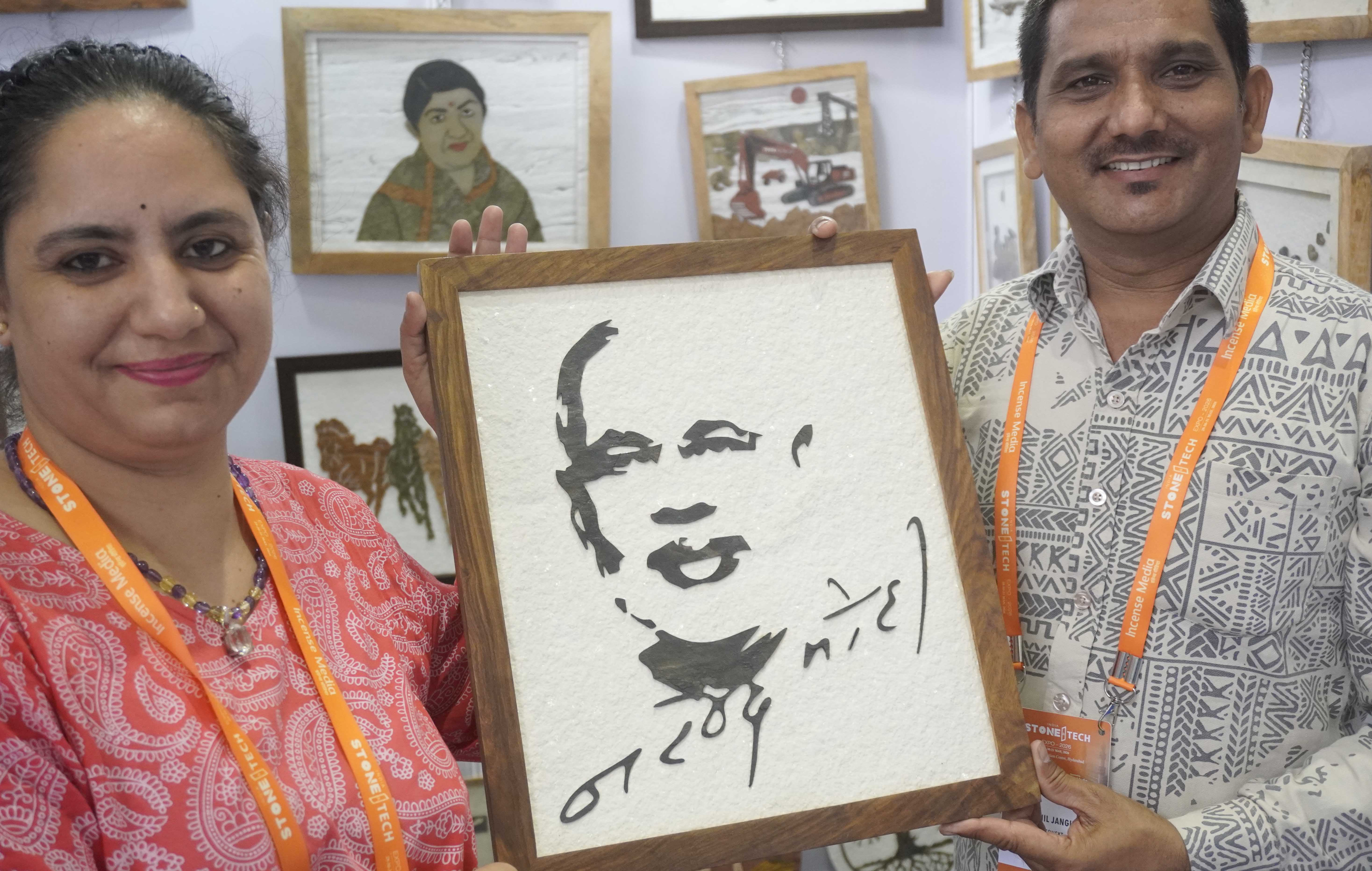
Among the unique attractions at the expo are the stunning pebble-art stone frames created by Jaipur-based artist couple Sunil Jangid and Poonam Sharma of Kaka Aakar. The duo transforms ordinary pebbles collected from riverbeds into extraordinary works of art, meticulously arranging each stone by shape, size, colour and texture to create intricate portraits, landscapes and thematic compositions.
One of their most notable creations is a portrait of Prime Minister Narendra Modi, crafted entirely from naturally sourced pebbles and later presented to him. Their artworks beautifully blend nature, creativity and craftsmanship, demonstrating how simple stones can be transformed into captivating visual masterpieces. The collection on display offers visitors a rare glimpse into an innovative art form that combines environmental consciousness with artistic excellence.
—