
India’s Data Centre Boom: Capacity Quadruples as Digital Demand Surges
India’s data centre industry is entering a high-growth phase, driven by rising digital consumption, regulatory push, and the rapid expansion of cloud and data-driven services. Over the past five years, the country’s data centre capacity has grown from 375 MW in 2020 to more than 1,500 MW in 2025, underscoring the scale of demand emerging from a digitising economy.
This fourfold expansion reflects more than infrastructure growth. It signals a structural shift in how India stores, processes, and secures its data as businesses, governments, and consumers increasingly move online.
Demand Drivers: Data Explosion Meets Policy Push
The surge in capacity is closely tied to India’s broader digital transformation. Rising internet penetration, cheaper data, and widespread adoption of digital platforms have led to an explosion in data generation.
At the same time, regulatory frameworks are shaping demand. The Reserve Bank of India’s mandate requiring payment system data to be stored locally has accelerated investments in domestic data infrastructure. Similar trends are expected across sectors such as fintech, e-commerce, and government services.
For hyperscalers, cloud providers, and enterprise players, India is no longer just a consumption market. It is becoming a critical data storage and processing hub.
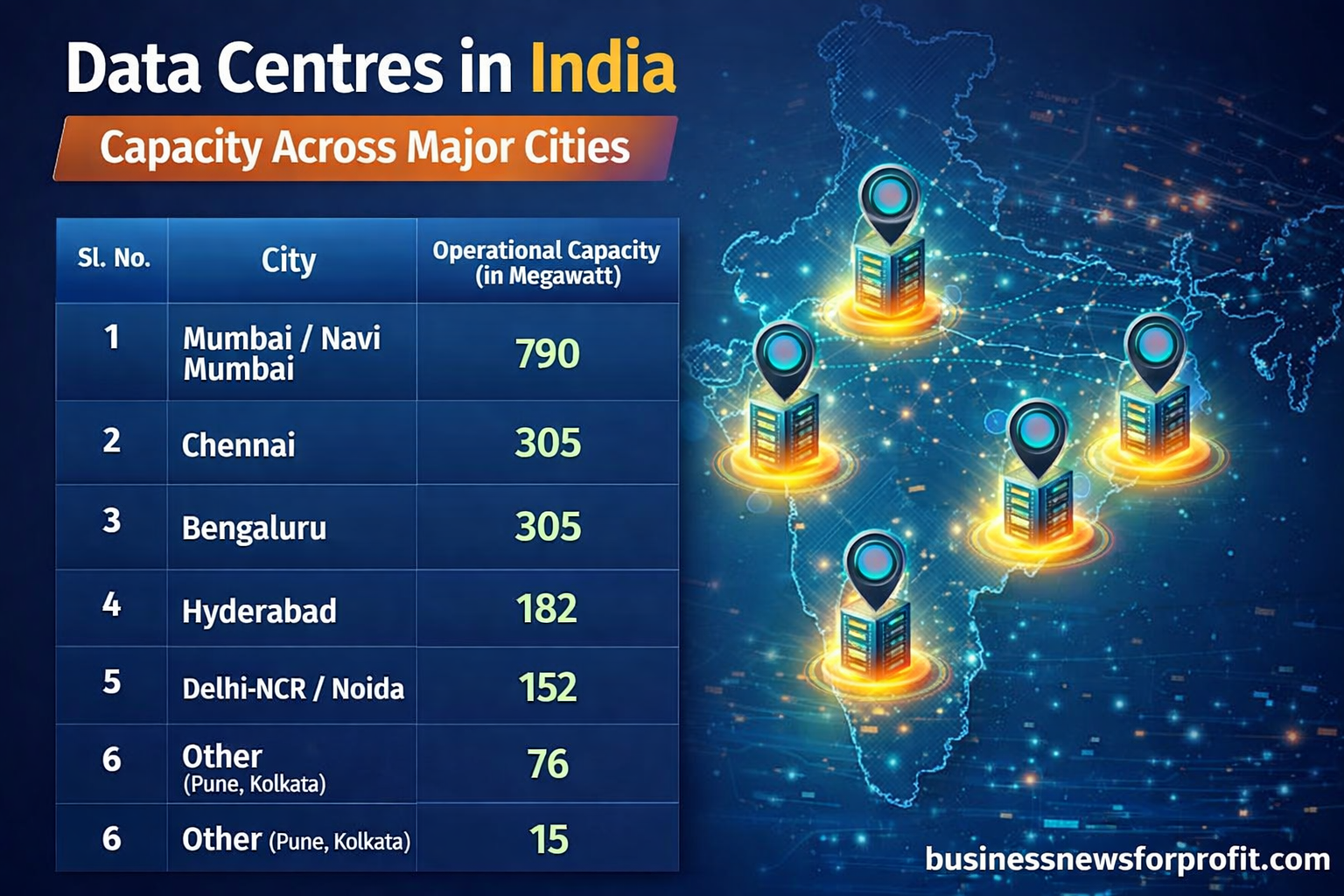
Mumbai Leads, Chennai Emerges
Geographically, data centre capacity remains concentrated in a few key hubs. Mumbai and Navi Mumbai dominate with around 790 MW of operational capacity, benefiting from strong connectivity and proximity to submarine cable landing stations.
Chennai has emerged as the second-largest hub with over 300 MW capacity, leveraging its strategic coastal location. Bengaluru, Hyderabad, and Delhi-NCR are also growing steadily, driven by enterprise demand and tech ecosystems.
Smaller markets like Pune and Kolkata are beginning to see early-stage development, indicating gradual geographic diversification.
Connectivity Backbone: Submarine Cables in Focus
India’s global data connectivity is being strengthened through new submarine cable systems. Four such systems are currently being commissioned at cable landing stations, while three more are in the planning stage.
These cables are critical for handling international data traffic, improving latency, and supporting cloud and hyperscale operations. As global data flows increase, robust submarine connectivity will be key to positioning India as a regional data hub.
However, the government has indicated that there are no immediate plans to establish new subsea gateways, suggesting a focus on optimising existing infrastructure.
Strategic Importance: Data Sovereignty and Security
The push for domestic data centre capacity is also tied to concerns around data sovereignty, cybersecurity, and regulatory compliance.
By ensuring that critical data is stored within the country, policymakers aim to create a more secure and accountable digital ecosystem. This is particularly relevant for sectors handling sensitive data, including finance, healthcare, and governance.
Investment Opportunity and Industry Outlook
The data centre sector is attracting significant investment from global hyperscalers, domestic conglomerates, and infrastructure funds. The combination of rising demand, policy support, and improving connectivity makes India one of the fastest-growing data centre markets globally.
Opportunities are emerging not just in core infrastructure, but also in allied areas such as renewable energy integration, cooling technologies, real estate, and edge computing.
Challenges Ahead
Despite strong growth, the sector faces challenges. High energy consumption, land acquisition issues, and the need for reliable power supply remain key constraints. Additionally, as capacity expands, maintaining efficiency and sustainability will become critical.
Bottom Line
India’s data centre expansion reflects the country’s transition into a data-driven economy. With capacity scaling rapidly and connectivity improving, the country is positioning itself as a key node in global digital infrastructure.
For investors and businesses, the message is clear: India’s next infrastructure boom is not just physical, it is digital.
