UPES Advances Industry–Academia Collaboration at DrishtiKone 2.0 in Mumbai
UPES Advances Industry–Academia Collaboration at DrishtiKone 2.0 in Mumbai Exclusive platform for senior industry leaders examines how AI is reshaping executive judgement, talent and education
Mumbai, Feb 10: UPES Dehradun, a leading multidisciplinary and research university, hosted the second edition of DrishtiKone in Mumbai. Conceived as a long-term strategic platform by UPES, DrishtiKone is an invitation-only, closed-door leadership forum— a high-trust “thinking room” where senior industry leaders and UPES academic leadership engage in conversations on the future of work, talent and learning. It creates a rare space where perspectives are shared openly, hard questions are addressed responsibly, and future-facing ideas translate into stronger alignment between industry and education. It is deliberately curated to bring some of the most sought-after CXOs, business heads and experts from marquee organisations into one room—not for speeches, but for honest exchange and practical insight.
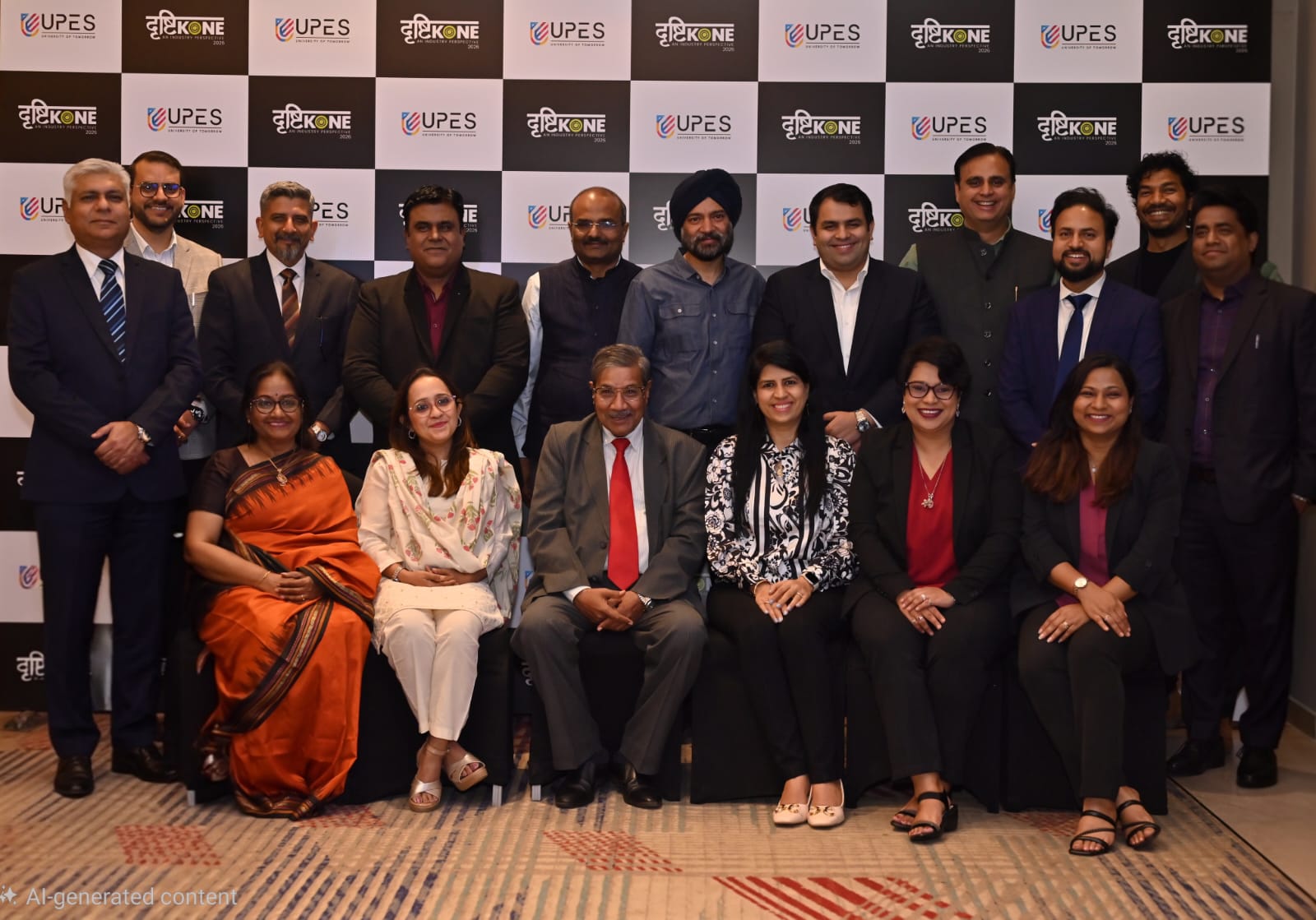
This edition of Drishtikone focused on leadership and learning in an AI-driven world.Anchored around the theme, “The Confluence of Artificial Intelligence and Human Intelligence,” the forum brought together senior leaders from diverse sectors, including Sumit Kapoor, Partner, Risk Advisory, KPMG in India; Sameer Pitalwalla, Head of Gaming – APAC, Google Cloud; Lakshmi Deshpande, Head of XR Innovation & Design, TCS; G. S. Selwyn, Executive Vice President, Rolls-Royce in India & Managing Director, MTU India; Dr. Nilay Ranjan, Head CSR and Sustainability, Air India; Harjeet Khanduja, SVP – HR, Jio; Azmina Poddar, Managing Director – Experience Design, JPMorgan Chase and Ravi Hemnani, Vice President – HR & Head, Talent & Learning, Nuvoco Vistas Corp. Ltd. The dialogue examined how AI is influencing executive decision-making and organisational capability—while reinforcing the enduring importance of human judgement, ethics, accountability and consequence.
The session opened with a welcome address by Dr. Sunil Rai, Vice Chancellor, UPES. The context and session overview were set by Mr. Manish Madaan, Registrar, UPES, along with the UPES Alliances team, before the forum moved into the core boardroom conversations. These conversations were convened by Prof. Rajiv Nandwani, Senior Director, UPES School of Computer Science; Prof. Bhaskar Bhatt, Dean, School of Design, and Dr. Padma Venkat, Dean, School of Health Sciences and Technology and concluded with a closing note and group photograph, followed by dinner and informal dialogue.
The evening featured three interconnected boardroom conversations. The first, AI & Executive Judgement, examined how AI is increasingly shaping executive decisions—and where leadership must draw clear, non-negotiable boundaries for human judgement, with a focus on accountability, ethics and contextual intelligence. The second, The Learning Paradigm & AI-First Talent, explored shifting hiring paradigms, curriculum design, student engagement, and the Institutional AI Stack—spanning infrastructure, intelligence, integration and impact. The third and final session, Industry–Academia Convergence, focused on how collaboration models must evolve beyond transactional engagement towards co-creation and shared responsibility for future workforce design and long-term capability building.
A shared message emerged across DrishtiKone 2.0: AI will reshape work at speed, but outcomes, accountability and human judgement must remain at the centre. Sumit Kapoor,Partner, Risk Advisory, KPMG in India, said,
“AI can support fact-based decisions, but humans must remain accountable. In the boardroom, with thousands of solutions available, leaders must bring intelligent problems to the table, to unlock AI’s potential and create a layer of trust in terms of the outcome. It is extremely important for business leaders to have meaningful conversations with enterprise AI to ensure that it gets trained in the right way to solve for complex issues and build character, something AI cannot do.” Echoing this, G. S. Selwyn, Executive Vice President, Rolls-Royce in India & Managing Director, MTU India said, “AI may boost speed, volume and consistency, but decision-making still demands context, values and consequences, making the human-in-the-loop non-negotiable.” He also added, “As educators, professionals, and industry leaders, we need to shift from skill-led development to product-focused thinking that is purpose-led, to build better judgment and create larger impact.” Adding to this, Azmina Poddar, Managing Director – Experience Design, JPMorgan Chase said, “The human element in the loop is never going to go away. Even with all that AI and agentic systems have achieved so far, and though we deploy them extensively in the backend operations, we still do not trust them with clients, especially in the financial sector.”
Speaking on the occasion, Dr. Sunil Rai, Vice Chancellor, UPES said,
“At a time when new-age technologies like artificial intelligence are fundamentally reshaping leadership, talent, and learning, at UPES, we see it as our responsibility to harness its potential to create a meaningful positive impact on society. We believe in not only preparing students for today’s roles, but in helping shape the conversations that define the future of work. By bringing diverse leaders together through DrishtiKone, we aim to ensure that we remain closely aligned with the industry on critical points in shaping the talent of tomorrow with focus on their ‘deployability’, curriculum and training.”
DrishtiKone positions UPES as a convener of future-facing leadership dialogue, designed to catalyse long-term strategic relationships built on trust, insight and shared outcomes, while strengthening university–industry convergence in the AI era. What makes DrishtiKone impactful is that it enables real perspectives, sharper alignment between industry and education, which aligns with UPES’s focus as the University of Tomorrow, to create leaders who will shape what comes next.