
International SOS Travel Advisory for Business Travellers Travelling in Cities with Air Pollution
During periods of high air pollution:
People who are especially vulnerable to health problems caused by polluted air, such as older adults, young children, those with heart or lung disease, including asthma, should consider postponing travel until conditions have improved.
Be aware that disruption to air travel is likely during times of poor visibility. Seek itinerary-specific advice prior to travel.
People in affected areas, especially older adults, young children, and those with heart or lung disease, are advised to:
- check air quality measurements, if available
- follow the advice of local authorities.
- minimize time outdoors.
- reduce physical exertion.
- keep windows and doors closed.
- consider using an air cleaning device.
- use air conditioners in ‘recirculate’ mode.
- consider avoiding heavy traffic areas.
· consider using a respirator (N95 mask) while outdoors (consult your doctor for an individual recommendation). N95 respirators will provide some protection against inhaling small particles, though they do not protect against noxious gases.
· consult your medical practitioner if you experience symptoms.
· if very high levels of pollution are likely to persist for some time, consider temporarily relocating to an area with better air quality if personal circumstances permit.
Background
Air pollution is one of the major environmental concerns in the country. Major cities such as New Delhi experience high levels of air pollution on an ongoing basis. The main pollutant is fine particulate matter (PM2.5) from transport sources. Non-vehicular sources of pollution include the burning of construction dust, refuse and tyres in Delhi and surrounding states. New Delhi is one of the most polluted cities in the world. On an average PM2.5 is at least 15 times higher than the WHO air quality guidelines.
In other parts of India, growth in many sectors including industries, transportation, power generation and construction have led to deterioration in air quality.
Seasonality
Pollution is seen to rise in the northern parts during the winter months, from November to January each year.
The air quality begins to decline around early October due to agricultural burning in neighboring regions such as Punjab, Haryana and Uttar Pradesh. This adds to the air pollution caused by vehicular and industrial emissions. Additionally, the AQI deteriorates further after “Diwali” festival which falls during October/November. Extensive use of fireworks hugely impacts air quality every year.
All these factors contribute to haze in Delhi and NCR, particularly during the colder months. Haze persists throughout the winter which typically starts in mid-November and lasts until late February.
Monitoring air pollution
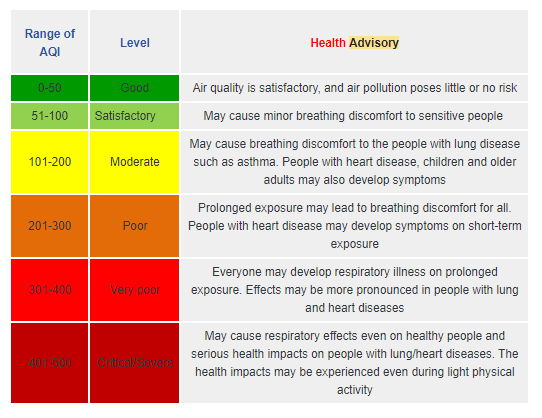
The Central Pollution Control Board (CPCB), Ministry of Environment and Forest monitors and controls the quality of air nationally. Real time air quality data is published hourly across several monitoring stations nationwide. Forecasts are not published. A daily AQI Bulletin is also published. The air quality index (AQI) scale followed by CPCB is called the National Air Quality Index (NAQI). Pollutants measured are particulate matter PM2.5 and PM10, nitrogen dioxide (NO2), ozone (O3), carbon monoxide (CO), sulphur dioxide (SO2), ammonia (NH3) and lead (Pb). A Graded Response Action Plan for Delhi and NCR is available.
SAFAR (System of Air Quality and Weather Forecasting and Research),, Ministry of Earth Science, Government of India – monitors air quality across a few Indian cities – Ahmedabad, Delhi, Mumbai and Pune. Air quality reports include the current status and forecasts (One and three days in advance). It also includes information on weather and UV radiation (for Mumbai and Pune). Pollutants monitored include PM2.5, PM10, ozone, carbon monoxide, oxides of nitrogen and hydrocarbons. The SAFAR AQI scale closely resembles NAQI.
The U.S Embassy’s air pollution monitor measures air quality around the Embassy premises of New Delhi, Chennai, Mumbai, Hyderabad and Kolkata.Data is displayed using the Air Quality Index.. Only PM2.5 is measured and readings are converted to AQI. Mission India introduced a new category titled “Beyond Index” for AQI readings above 500. This is not included in the EPA’s AQI scale and EPA does not provide any health advice for these levels.
The National Air Quality Index (AQI)