
Centre, States Sign Reform MoUs to Strengthen Rural Water Governance under Jal Jeevan Mission 2.0
New Delhi, March 18: In a major step to strengthen rural drinking water governance, the Government of India has signed reform-linked Memorandums of Understanding (MoUs) with the states of Rajasthan and Madhya Pradesh under the extended phase of the Jal Jeevan Mission (JJM) 2.0. The agreements mark the formal rollout of the reform-based implementation framework of the mission, which was approved by the Union Cabinet on March 10, 2026.
The MoU with Rajasthan was signed in the presence of Union Minister of Jal Shakti C. R. Patil, Chief Minister Bhajan Lal Sharma, and Minister of State for Jal Shakti V. Somanna. The ceremony was attended by Rajasthan’s Public Health Engineering Department (PHED) Minister Kanhaiya Lal Choudhary and senior officials from both the Centre and the state government.
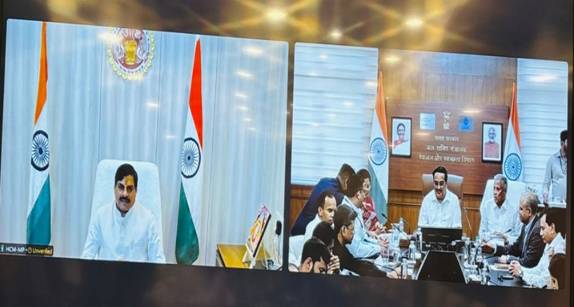
Later in the day, a similar MoU was signed with Madhya Pradesh in the presence of Union Minister C. R. Patil and Chief Minister Mohan Yadav, who joined the event through video conferencing. Madhya Pradesh PHED Minister Sampatiya Uikey and other senior officials were also present.
Senior officials from the Department of Drinking Water and Sanitation (DDWS), including Secretary Ashok K. K. Meena and Additional Secretary and Mission Director (NJJM) Kamal Kishore Soan, attended the MoU signing ceremonies.
For Rajasthan, the agreement was signed between Swati Meena Naik, Joint Secretary (Water), DDWS, and Akhil Arora, Additional Chief Secretary, PHED Rajasthan. For Madhya Pradesh, the MoU was signed between Swati Meena Naik and P. Narahari, Principal Secretary, PHED Madhya Pradesh.
Addressing the gathering, Union Minister C. R. Patil reiterated the Union government’s zero-tolerance policy toward corruption and stressed that quality, transparency and accountability must guide all works under the Jal Jeevan Mission. He urged both states to maintain strict quality standards to ensure that water supply assets remain functional and sustainable in the long term.
Highlighting the different water challenges faced by the two states—including water scarcity in Rajasthan and diverse hydro-geological conditions in Madhya Pradesh—the minister praised both governments for proactively adopting the reform-linked framework.
He also emphasised that effective implementation of the mission would significantly reduce the burden on women and girls, particularly in water-stressed rural regions, while ensuring reliable and safe drinking water supply for households.
Rajasthan Chief Minister Bhajan Lal Sharma reaffirmed the state’s commitment to implementing Jal Jeevan Mission reforms with a focus on timely execution, institutional strengthening and long-term sustainability of rural drinking water systems.
Similarly, Madhya Pradesh Chief Minister Mohan Yadav said the state would fully align with the national reform agenda and work toward strengthening governance systems, improving service delivery and achieving the goal of 24×7 drinking water supply in rural areas.
The MoUs outline 11 key structural reform areas aimed at strengthening governance and sustainability in rural drinking water systems. These include institutional architecture for water governance, service utility frameworks, technical compliance in scheme implementation, citizen-centric water quality governance, water source sustainability, digital data governance, participatory governance through community involvement, capacity building, human resource development, operational and financial sustainability of water supply systems, and research and innovation.
A key feature of the reform framework is a Gram Panchayat-led model of water governance, under which completed piped water supply schemes will be handed over to Gram Panchayats and Village Water and Sanitation Committees (VWSCs) through the “Jal Arpan” process.
The MoU also calls for operationalising a Decision Support System (DSS) developed by DDWS as a digital planning tool for districts and Gram Panchayats to improve water source sustainability and planning.
In addition, the agreement provides for “Jal Seva Aankalan” at the Gram Panchayat level to assess service delivery and share results with citizens through the Meri Panchayat mobile application.
The reform agenda also includes the Jal Utsav initiative, a nationwide awareness campaign celebrating the importance of water through three tiers—Jal Mahotsav at the national level, Rajya Jal Utsav or Nadi Utsav at the state level, and Lok Jal Utsav at the Gram Panchayat level. As part of this initiative, National Jal Mahotsav 2026 began with a nationwide Jal Arpan event on March 8, 2026, and will culminate on March 22, World Water Day. The national event held on March 11 was attended by the President of India Droupadi Murmu.
The extension of Jal Jeevan Mission until December 2028 with enhanced financial outlay aims to shift the programme’s focus toward assured service delivery, water quality, system functionality, sustainability and community ownership.
Through the reform-linked framework, the government aims to ensure that every rural household receives adequate, safe drinking water on a regular basis, strengthening community participation and improving living standards while contributing to long-term water security under the national vision of Viksit Bharat @2047.
