
Conference on From Tax Inquiry to Enforcement Action: Understanding ED, PMLA & Financial Compliance Proceedings
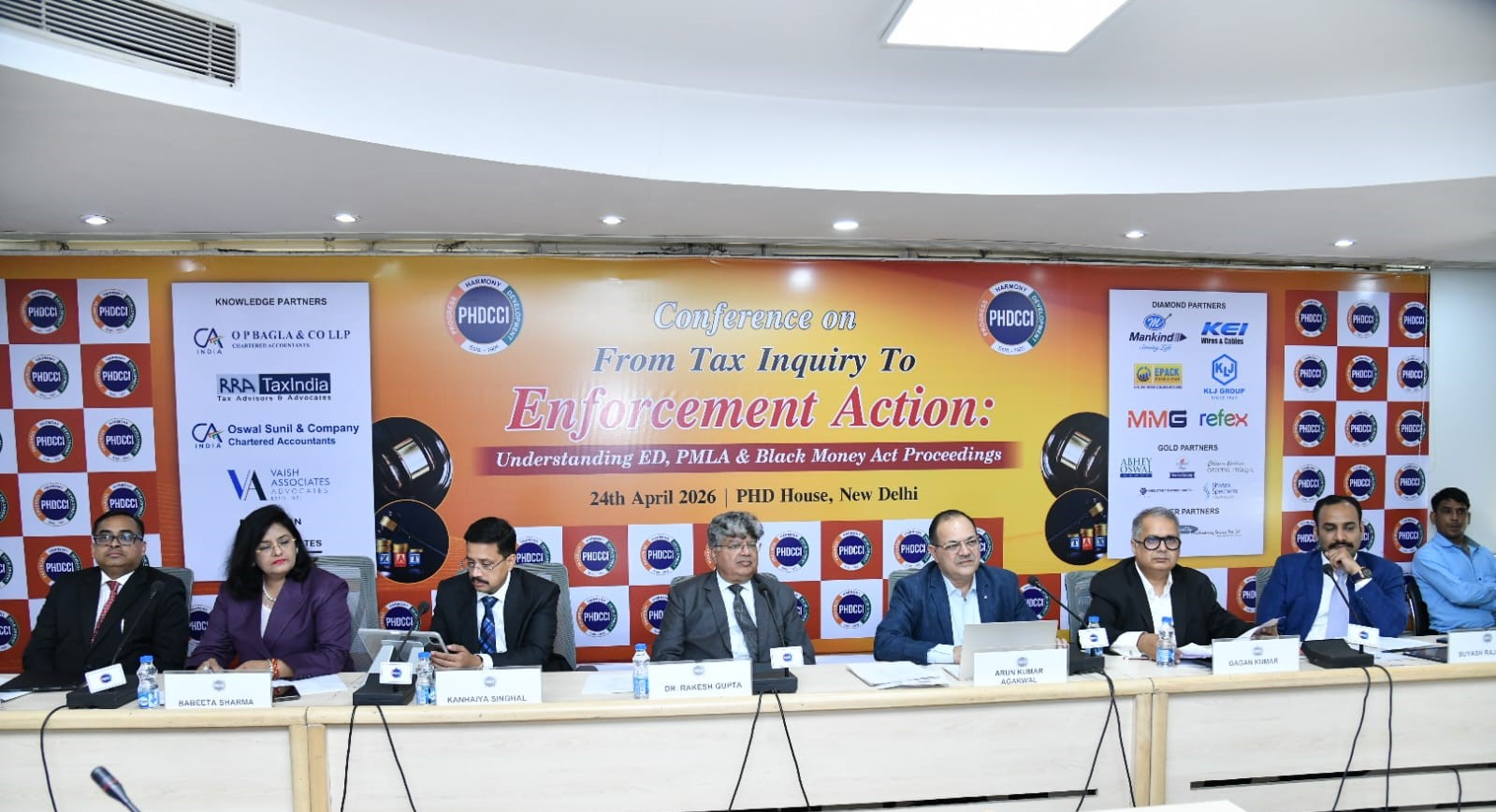
The PHD Chamber of Commerce and Industry (PHDCCI) successfully organized a conference on “From Tax Inquiry to Enforcement Action: Understanding ED, PMLA & Black Money Act Proceedings”, bringing together leading experts, legal practitioners, and industry stakeholders to deliberate on evolving enforcement trends in financial and tax-related laws.
Welcoming the participants, Ms. Babeeta Sharma, Director, PHDCCI highlighted the importance and relevance of the conference. She emphasized that the topic holds immense significance in the current regulatory environment, given the increasing focus on enforcement actions under tax and financial laws.
Dr. Rakesh Gupta, Co-Chair, Direct Tax Committee, PHD Chamber of Commerce and Industry, highlighted the importance of understanding enforcement under the Prevention of Money Laundering Act, 2002 and the Black Money (Undisclosed Foreign Income and Assets) and Imposition of Tax Act, 2015.He noted that while these laws are critical, their selective application often raises concerns, and once a default is established, the burden of proof becomes stringent. He expressed confidence that the session would offer valuable insights into the shift from tax inquiries to enforcement actions.
Arun Kumar Agarwal, Former Member & Acting Chairperson, Appellate Tribunal under PMLA , elaborated on the legal framework of money laundering. He explained that an offence of money laundering involves direct or indirect engagement in activities connected with proceeds of crime, including concealment, possession, acquisition, use, or projection of such proceeds as untainted property. He emphasized that the term “proceeds of crime” encompasses any property derived from criminal activity or its equivalent value. He also noted that since its enactment, the PMLA has undergone several amendments, including significant changes in 2019, strengthening enforcement provisions.
Kanhaiya Singhal, Advocate, Supreme Court of India, discussed the concept of reverse burden of proof and presumption of guilt under PMLA, along with the retrospective applicability of the Black Money Act. He remarked, “The concept of burden of proof is not limited to law; it is part of our everyday lives. As per the fundamental principle under Section 101 of the Indian Evidence Act, 1872, the person who asserts a fact must prove it. Proof involves establishing facts through evidence and documentation before a competent authority. However when it comes to reverse burden of proof as per PMLA, it is defendant, who is facing charges of having property which is proceeds of crime or acquired from the proceeds of crime, is required to show that it is acquired through his own legitimate means.’
Suyash Raj Nahata, Co-Chair, Direct Tax Committee, PHDCCI , raised several pertinent questions addressing key legal and practical challenges around the subject. He highlighted critical issues emerging from enforcement trends and stakeholder concerns, and effectively summed up the session by encapsulating the key takeaways and insights shared by the panel, providing a clear and thoughtful conclusion to the discussions.
Gagan Kumar, Partner at Khaitan Legal Associates, highlighted that courts treat white-collar crimes with utmost seriousness due to their deliberate nature. He emphasized the broad scope of Section 50 under the Prevention of Money Laundering Act, 2002, noting that even professionals may fall within its ambit. The conference concluded with an engaging discussion, reinforcing the need for awareness and preparedness in navigating evolving enforcement frameworks.
Rohit Jain, Partner at Vaish Associates, explained the concept of Benami transactions prior to 1988, noting that such arrangements involved property held in another person’s name without any real beneficial interest. He highlighted that these were broadly classified into two types—Tripartite and Bipartite transactions—based on their structure and parties involved. He also discussed the legal position of Benami transactions prior to 1988 and their treatment under other applicable laws.
The seminar was efficiently coordinated by Ms. Minakshi Srivastava, Deputy Secretary, PHDCCI, ensuring its smooth and successful conduct.
